 Add to Chrome
 Add to Firefox
 Add to Edge
LL-Bench: Rethinking Low-Level Vision Evaluation in the Era of Large-Scale Generative Models
Jun 01, 2026
Large-scale generative models have demonstrated remarkable capabilities across image generation and editing tasks. However, their performance in low-level vision tasks, which require pixel-wise control, remains insufficiently studied. To address this gap, we introduce \textbf{LL-Bench}, a comprehensive \textbf{Benchmark} for evaluating the capabilities of large-scale generative models on \textbf{L}ow-\textbf{L}evel vision tasks. The benchmark comprises 2,469 real-world degraded images covering 16 low-level degradation tasks, and 28,919 restored images produced by 10 state-of-the-art large-scale generative models and 21 conventional restoration models, which are annotated with 152,020 expert-level pairwise human preferences and 28,334 quality scores. Built upon LL-Bench, we present a systematic diagnosis that reveals the performance boundaries and unique failure modes of large-scale generative models across diverse low-level vision tasks, compared with conventional representative restoration approaches. Moreover, we investigate the effectiveness of current quality evaluation metrics on LL-Bench, which exhibit significant discrepancy with human ratings. To better align restored-image quality assessment with human preferences, we further propose \textbf{LL-Score}, an MLLM-based evaluator that captures both restoration quality and hallucination existence. Extensive experiments demonstrate that LL-score not only outperforms existing image quality assessment metrics, but also serves as a promising reward model for training generative models on low-level vision tasks.

A2BFR: Attribute-Aware Blind Face Restoration
Mar 31, 2026Blind face restoration (BFR) aims to recover high-quality facial images from degraded inputs, yet its inherently ill-posed nature leads to ambiguous and uncontrollable solutions. Recent diffusion-based BFR methods improve perceptual quality but remain uncontrollable, whereas text-guided face editing enables attribute manipulation without reliable restoration. To address these issues, we propose A$^2$BFR, an attribute-aware blind face restoration framework that unifies high-fidelity reconstruction with prompt-controllable generation. Built upon a Diffusion Transformer backbone with unified image-text cross-modal attention, A$^2$BFR jointly conditions the denoising trajectory on both degraded inputs and textual prompts. To inject semantic priors, we introduce attribute-aware learning, which supervises denoising latents using facial attribute embeddings extracted by an attribute-aware encoder. To further enhance prompt controllability, we introduce semantic dual-training, which leverages the pairwise attribute variations in our newly curated AttrFace-90K dataset to enforce attribute discrimination while preserving fidelity. Extensive experiments demonstrate that A$^2$BFR achieves state-of-the-art performance in both restoration fidelity and instruction adherence, outperforming diffusion-based BFR baselines by -0.0467 LPIPS and +52.58% attribute accuracy, while enabling fine-grained, prompt-controllable restoration even under severe degradations.
MuDD: A Multimodal Deception Detection Dataset and GSR-Guided Progressive Distillation for Non-Contact Deception Detection
Mar 27, 2026Non-contact automatic deception detection remains challenging because visual and auditory deception cues often lack stable cross-subject patterns. In contrast, galvanic skin response (GSR) provides more reliable physiological cues and has been widely used in contact-based deception detection. In this work, we leverage stable deception-related knowledge in GSR to guide representation learning in non-contact modalities through cross-modal knowledge distillation. A key obstacle, however, is the lack of a suitable dataset for this setting. To address this, we introduce MuDD, a large-scale Multimodal Deception Detection dataset containing recordings from 130 participants over 690 minutes. In addition to video, audio, and GSR, MuDD also provides Photoplethysmography, heart rate, and personality traits, supporting broader scientific studies of deception. Based on this dataset, we propose GSR-guided Progressive Distillation (GPD), a cross-modal distillation framework for mitigating the negative transfer caused by the large modality mismatch between GSR and non-contact signals. The core innovation of GPD is the integration of progressive feature-level and digit-level distillation with dynamic routing, which allows the model to adaptively determine how teacher knowledge should be transferred during training, leading to more stable cross-modal knowledge transfer. Extensive experiments and visualizations show that GPD outperforms existing methods and achieves state-of-the-art performance on both deception detection and concealed-digit identification.
ECHO: Towards Emotionally Appropriate and Contextually Aware Interactive Head Generation
Mar 18, 2026In natural face-to-face interaction, participants seamlessly alternate between speaking and listening, producing facial behaviors (FBs) that are finely informed by long-range context and naturally exhibit contextual appropriateness and emotional rationality. Interactive Head Generation (IHG) aims to synthesize lifelike avatar head video emulating such capabilities. Existing IHG methods typically condition on dual-track signals (i.e., human user's behaviors and pre-defined audio for avatar) within a short temporal window, jointly driving generation of avatar's audio-aligned lip articulation and non-verbal FBs. However, two main challenges persist in these methods: (i) the reliance on short-clip behavioral cues without long-range contextual modeling leads them to produce facial behaviors lacking contextual appropriateness; and (ii) the entangled, role-agnostic fusion of dual-track signals empirically introduces cross-signal interference, potentially compromising lip-region synchronization during speaking. To this end, we propose ECHO, a novel IHG framework comprising two key components: a Long-range Contextual Understanding (LCU) component that facilitates contextual understanding of both behavior-grounded dynamics and linguistic-driven affective semantics to promote contextual appropriateness and emotional rationality of synthesized avatar FBs; and a block-wise Spatial-aware Decoupled Cross-attention Modulation (SDCM) module, that preserves self-audio-driven lip articulation while adaptively integrating user contextual behavioral cues for non-lip facial regions, complemented by our designed two-stage training paradigm, to jointly enhance lip synchronization and visual fidelity. Extensive experiments demonstrate the effectiveness of proposed components and ECHO's superior IHG performance.
RieMind: Geometry-Grounded Spatial Agent for Scene Understanding
Mar 16, 2026Visual Language Models (VLMs) have increasingly become the main paradigm for understanding indoor scenes, but they still struggle with metric and spatial reasoning. Current approaches rely on end-to-end video understanding or large-scale spatial question answering fine-tuning, inherently coupling perception and reasoning. In this paper, we investigate whether decoupling perception and reasoning leads to improved spatial reasoning. We propose an agentic framework for static 3D indoor scene reasoning that grounds an LLM in an explicit 3D scene graph (3DSG). Rather than ingesting videos directly, each scene is represented as a persistent 3DSG constructed by a dedicated perception module. To isolate reasoning performance, we instantiate the 3DSG from ground-truth annotations. The agent interacts with the scene exclusively through structured geometric tools that expose fundamental properties such as object dimensions, distances, poses, and spatial relationships. The results we obtain on the static split of VSI-Bench provide an upper bound under ideal perceptual conditions on the spatial reasoning performance, and we find that it is significantly higher than previous works, by up to 16\%, without task specific fine-tuning. Compared to base VLMs, our agentic variant achieves significantly better performance, with average improvements between 33\% to 50\%. These findings indicate that explicit geometric grounding substantially improves spatial reasoning performance, and suggest that structured representations offer a compelling alternative to purely end-to-end visual reasoning.
GeodesicNVS: Probability Density Geodesic Flow Matching for Novel View Synthesis
Mar 01, 2026Recent advances in generative modeling have substantially enhanced novel view synthesis, yet maintaining consistency across viewpoints remains challenging. Diffusion-based models rely on stochastic noise-to-data transitions, which obscure deterministic structures and yield inconsistent view predictions. We propose a Data-to-Data Flow Matching framework that learns deterministic transformations directly between paired views, enhancing view-consistent synthesis through explicit data coupling. To further enhance geometric coherence, we introduce Probability Density Geodesic Flow Matching (PDG-FM), which constrains flow trajectories using geodesic interpolants derived from probability density metrics of pretrained diffusion models. Such alignment with high-density regions of the data manifold promotes more realistic interpolants between samples. Empirically, our method surpasses diffusion-based NVS baselines, demonstrating improved structural coherence and smoother transitions across views. These results highlight the advantages of incorporating data-dependent geometric regularization into deterministic flow matching for consistent novel view generation.
HierLoc: Hyperbolic Entity Embeddings for Hierarchical Visual Geolocation
Jan 30, 2026Visual geolocalization, the task of predicting where an image was taken, remains challenging due to global scale, visual ambiguity, and the inherently hierarchical structure of geography. Existing paradigms rely on either large-scale retrieval, which requires storing a large number of image embeddings, grid-based classifiers that ignore geographic continuity, or generative models that diffuse over space but struggle with fine detail. We introduce an entity-centric formulation of geolocation that replaces image-to-image retrieval with a compact hierarchy of geographic entities embedded in Hyperbolic space. Images are aligned directly to country, region, subregion, and city entities through Geo-Weighted Hyperbolic contrastive learning by directly incorporating haversine distance into the contrastive objective. This hierarchical design enables interpretable predictions and efficient inference with 240k entity embeddings instead of over 5 million image embeddings on the OSV5M benchmark, on which our method establishes a new state-of-the-art performance. Compared to the current methods in the literature, it reduces mean geodesic error by 19.5\%, while improving the fine-grained subregion accuracy by 43%. These results demonstrate that geometry-aware hierarchical embeddings provide a scalable and conceptually new alternative for global image geolocation.
FedAdaVR: Adaptive Variance Reduction for Robust Federated Learning under Limited Client Participation
Jan 29, 2026Federated learning (FL) encounters substantial challenges due to heterogeneity, leading to gradient noise, client drift, and partial client participation errors, the last of which is the most pervasive but remains insufficiently addressed in current literature. In this paper, we propose FedAdaVR, a novel FL algorithm aimed at solving heterogeneity issues caused by sporadic client participation by incorporating an adaptive optimiser with a variance reduction technique. This method takes advantage of the most recent stored updates from clients, even when they are absent from the current training round, thereby emulating their presence. Furthermore, we propose FedAdaVR-Quant, which stores client updates in quantised form, significantly reducing the memory requirements (by 50%, 75%, and 87.5%) of FedAdaVR while maintaining equivalent model performance. We analyse the convergence behaviour of FedAdaVR under general nonconvex conditions and prove that our proposed algorithm can eliminate partial client participation error. Extensive experiments conducted on multiple datasets, under both independent and identically distributed (IID) and non-IID settings, demonstrate that FedAdaVR consistently outperforms state-of-the-art baseline methods.
FedOAED: Federated On-Device Autoencoder Denoiser for Heterogeneous Data under Limited Client Availability
Dec 19, 2025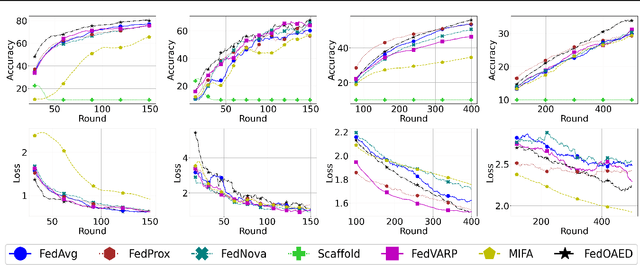
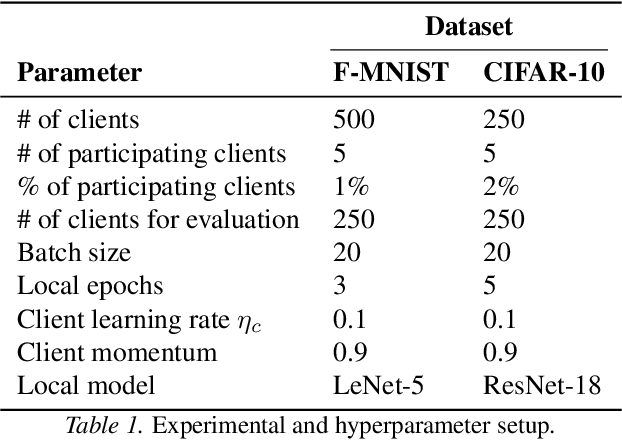
Over the last few decades, machine learning (ML) and deep learning (DL) solutions have demonstrated their potential across many applications by leveraging large amounts of high-quality data. However, strict data-sharing regulations such as the General Data Protection Regulation (GDPR) and the Health Insurance Portability and Accountability Act (HIPAA) have prevented many data-driven applications from being realised. Federated Learning (FL), in which raw data never leaves local devices, has shown promise in overcoming these limitations. Although FL has grown rapidly in recent years, it still struggles with heterogeneity, which produces gradient noise, client-drift, and increased variance from partial client participation. In this paper, we propose FedOAED, a novel federated learning algorithm designed to mitigate client-drift arising from multiple local training updates and the variance induced by partial client participation. FedOAED incorporates an on-device autoencoder denoiser on the client side to mitigate client-drift and variance resulting from heterogeneous data under limited client availability. Experiments on multiple vision datasets under Non-IID settings demonstrate that FedOAED consistently outperforms state-of-the-art baselines.
GeoSceneGraph: Geometric Scene Graph Diffusion Model for Text-guided 3D Indoor Scene Synthesis
Nov 18, 2025Methods that synthesize indoor 3D scenes from text prompts have wide-ranging applications in film production, interior design, video games, virtual reality, and synthetic data generation for training embodied agents. Existing approaches typically either train generative models from scratch or leverage vision-language models (VLMs). While VLMs achieve strong performance, particularly for complex or open-ended prompts, smaller task-specific models remain necessary for deployment on resource-constrained devices such as extended reality (XR) glasses or mobile phones. However, many generative approaches that train from scratch overlook the inherent graph structure of indoor scenes, which can limit scene coherence and realism. Conversely, methods that incorporate scene graphs either demand a user-provided semantic graph, which is generally inconvenient and restrictive, or rely on ground-truth relationship annotations, limiting their capacity to capture more varied object interactions. To address these challenges, we introduce GeoSceneGraph, a method that synthesizes 3D scenes from text prompts by leveraging the graph structure and geometric symmetries of 3D scenes, without relying on predefined relationship classes. Despite not using ground-truth relationships, GeoSceneGraph achieves performance comparable to methods that do. Our model is built on equivariant graph neural networks (EGNNs), but existing EGNN approaches are typically limited to low-dimensional conditioning and are not designed to handle complex modalities such as text. We propose a simple and effective strategy for conditioning EGNNs on text features, and we validate our design through ablation studies.